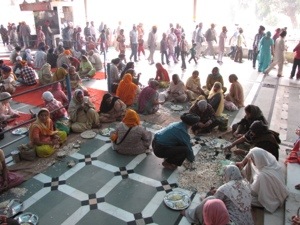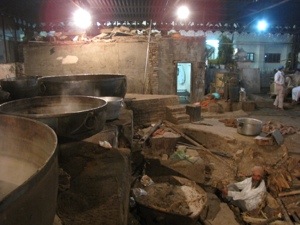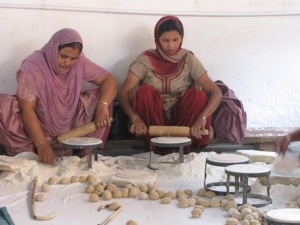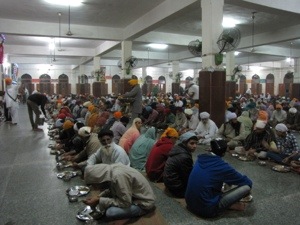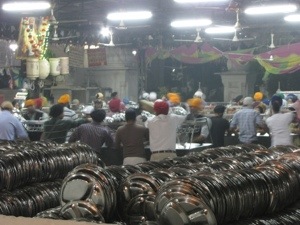
We also visited, both at night and the following day, the area of the temple called Guru Ka Langar which is basically a voluntary kitchen where they feed all the pilgrims and other people that come to visit the temple for free. Jane had heard about this place from Trip Advisor before we came and thought it might be a good place to eat whereas I had my reservations.
It’s an incredible place and the scale of the operation is enormous. We again felt privileged to be able to visit behind the scenes here both in the kitchens and then in the food hall where the folk get to eat. I asked our guide if it was only because we were with him that we got to wander about but he matter of factly said ‘No, anyone can come here -there are no restrictions.’
We started off in the area where they serve thousands of bowls of chai (tea) and thought this was very busy but then we went into the actual food hall and there were hundreds of people sitting on the floor waiting to be served their lunch on a silver plate. The estimates for how many people they can feed here on any one day vary between 10,000 and 100,000 but whatever it was – it was definitely a lot of people! We could have eaten here but to be honest it felt awkward as there were some incredibly poor people eating here and it didn’t feel right. However, then our guide told us that the idea here was of equality and that by all eating on the floor together it showed that there was no difference between the rich and poor. So that felt awkward too but no-one else seemed to mind.
After this we also had a little tour behind the scenes both at night and in the day of the kitchens. We saw where the large group of volunteers were preparing the huge piles of garlic and we saw the giggling man who tended the fires underneath the vast bowls of boiling broth. We also saw the groups of ladies hand rolling the chapatis and Joyce and Enid felt compelled to volunteer here which they did enthusiastically. Then we saw the huge German chapati making machine which could churn them out much faster but they probably don’t taste as good.
Finally we saw the area where they do the washing up. Again this is manned by volunteers who could be a local teacher who had popped in during a free period to give some time or a guy from Canada who has come all this way to do his service for a week. The atmosphere here was extremely organised but with a sense of sociable fun. I think we have found a place for Enid now that she is due to go part time and is looking to do some voluntary work.
In the end I was left asking the question here of ‘ Why couldn’t this model of voluntary giving on such a grand scale work elsewhere?
Posts Tagged With: Sikhism
No-one goes hungry in Amritsar
Lost for words at the Golden Temple
Randeep took us through the streets of Amritsar to the Golden Temple and by now it was dark and the streets a slightly calmer version of what we’d seen elsewhere. We had to be dropped off about a 10 min walk from the temple as the streets become too narrow here for a car or van to pass through. It was very busy with people coming and going but definitely all moving with a purpose.
At the entrance to the Golden Temple we had to take our shoes off and wash our hands. We also needed to cover our heads with the scarves we’d brought with us. As you walk towards the temple gate you have to walk through a small channel of very clean water. You then enter via one of the 4 gates (N,S,E & W) which represent the fact that people from all over are welcome and people of the 4 main religions of India (Sikh, Hindu, Muslim and Christian).
The sight that beholds you as you enter is truly awesome and I’m afraid that I was lost for words. Not something that happens very often and only the other day, whilst reflecting on how this blog was going, I said to Jane “Who knew I had so many words in my head?” to which she replied “I did, bab.” in her lovely Brummie way. I think she meant it kindly.
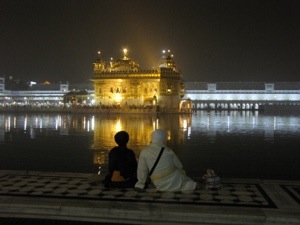
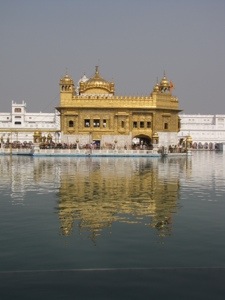
Anyway, I definitely think that night time is the best time to see the Golden Temple for the first time if you have a choice. There she sits shinning in the ‘pool of nectar’ which is the literal meaning of the word Amritsar. The reflections in the water look like liquid gold. It is really beautiful. A lot of people back home had told us that this was their favourite place in the world or their spiritual home and it was easy to see why the place means so much to them. It felt like an incredible privilege to be at the heart of somewhere of such religious importance and yet so inclusive and friendly. It was both lively and peaceful at the same time and we walked around the pool with everyone else being stopped again regularly by people who wanted their photo taken with us. People prostrate themselves as they enter and they like to take a ‘holy dip’ to purify themselves and to wash away previous sins. There is a kind of hypnotic music playing all the time which is actually being broadcast from live singing within the temple itself. This is people singing sections from the holy book which is what the people in the Sikh religion hold sacred. They treat the book as the ‘living master’ and so the book is kept covered when it is not being read from and put to bed each night to rest. There are copies of the book all around the temple which priests are constantly reading from.
The next day we returned to the temple with our new guide Jaswinder who was a lovely Sikh lad of 26 who I think rather enjoyed having a very attentive group of English ladies to entertain for the day! He was another great guide and took us inside the Golden Temple itself. There is a huge queue along the length of bridge to get in but it moves fast and once in the temple its a heady mix of fragrance from incense and marigolds. The music is playing and being sung hypnotically and the book is on the cushion. Some people just come to look, like us, whilst others just find a place to sit and read their little prayer books. I was amazed that we got to go in here and I even got to touch the golden roof itself as we went right up to the top. The temple is in fact gold plate over a layer of copper over the base of the building which is white marble.
Jaswinder also taught us a lot about the Sikh religion for example we learned about the 5 Ks which are important to those Sikhs who have chosen to be baptised.
Kesh is long hair kept in a turban
Kachha is a special kind of underwear
Kirpan is the small sword which must be kept on the person at ALL times
Kangha is the comb used for the hair
Kara is an iron and steel bracelet
We generally agreed that the principles that Sikhs hold to are pretty good ones:
> The book is the master
> Work hard and look after your family
> Give 10% of your earnings each year to charity either in money or time equivalent.
I’m going to leave it for a couple of separate posts to tell you about the kitchen situation and also to share with you the faces of some of the people we met. Suffice to say that this was definitely one of the absolute highlights of the trip so far.